Roth conversion plan for 2026 to 2035
Calculate how much to convert from a traditional IRA or 401(k) this year to fill the tax bracket you choose. The plan shows the federal tax, the state tax and the Medicare premium the conversion sets two years later. Start from the example values and change the ones that are yours. This year's answer is free and is calculated in your browser.
The ten-year plan is $39, once. It carries every year to 2035 and shows your RMDs and your surviving spouse's tax bill if you don't convert. Each year's number comes with a one-sentence reason. You get a PDF and a spreadsheet your CPA can check line by line.
Wages, pension, interest, and dividends, before Social Security
Convert this year to fill the 22% bracket
2026 · year one of ten · free14-day money-back guarantee. If the numbers don't check out, reply to your receipt and I'll refund you, no questions asked.
Converting $91,800 fills the 22% bracket to its top of $105,700, costing $16,546 in federal tax and $3,943 in state tax, and sets a $1,148 Medicare surcharge in 2028.
Stay under the first IRMAA tier instead: convert $79,000, pay $13,730 federal, and owe no surcharge in 2028. The ten-year plan shows both paths side by side.
What if you wait a year: 2027 headroom is about $99,667 on indexed 2026 figures, and at 6.0% the balance you would convert from grows to $636,000 by then.
The ten-year plan
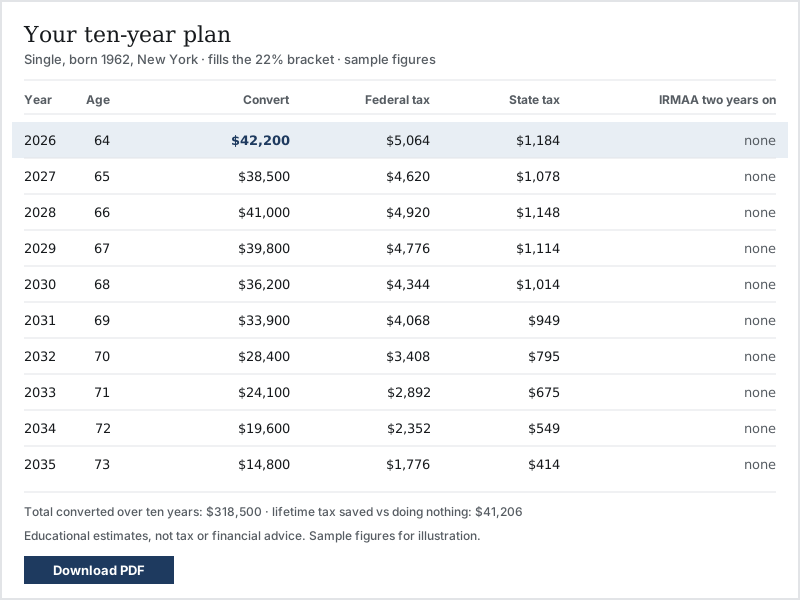
Every year's conversion, tax, and IRMAA consequence, plus what happens to your RMD at 75 if you do nothing.
| Year | Age | Convert | Federal tax | State tax | IRMAA two years on |
|---|---|---|---|---|---|
| 2026 | 64 | $91,800 | $16,546 | $3,943 | $1,148 in 2028 |
| 2027 | 65 | plan | |||
| 2028 | 66 | plan | |||
| 2029 | 67 | plan | |||
| 2030 | 68 | plan | |||
| 2031 | 69 | plan | |||
| 2032 | 70 | plan | |||
| 2033 | 71 | plan | |||
| 2034 | 72 | plan | |||
| 2035 | 73 | plan | |||
14-day money-back guarantee. If the numbers don't check out, reply to your receipt and I'll refund you, no questions asked.
One payment through Stripe. Your inputs are saved to a private link only you have, so the plan can be re-run each December.
What Tweed charges for, in full →What the $39 buys
All ten years at a private link that re-runs itself each December, the do-nothing comparison, your RMD at 75 both ways, the survivor case, the IRMAA path that avoids every cliff, this year's safe-harbor payment, a PDF, a spreadsheet with live formulas, and a calendar of deadlines.
What it is not
The plan is not advice: it fills the bracket you chose and never tells you to convert. Every figure traces to an IRS, SSA or CMS source printed on the report.
What annual planners charge
Annual planners charge $120 to $150 a year and ask for your whole financial life before the Roth module means anything. This answers one question for $39, once.
Your inputs never leave your browser until you buy. A paid plan is saved to a private link only you have.
Figures from IRS, SSA and CMS sources.
In this article
- How the plan is calculated
- 2026 figures the plan uses
- The two-year IRMAA look-back
- Roth conversion plan example: A single filer with $600,000 in an IRA
- Roth conversion rules
- When a conversion does not make sense
- How Roth conversions change a surviving spouse's tax bill
- Frequently asked questions about Roth conversion plans
How the plan is calculated
- Baseline taxable income for the year: other income, taxable Social Security, and any RMD.4
- Headroom to the top of your target bracket after the standard deduction and any age-65 additions.1
- Federal tax on the conversion, bracket by bracket, using the pro-rata rule for any after-tax basis.
- State tax from your state's 2026 treatment of retirement income.
- IRMAA two years later, from this year's MAGI against the 2026 tiers indexed at your inflation assumption.
- RMD at your applicable age with and without the plan, from the IRS Uniform Lifetime Table.3
- Lifetime tax and balances under both paths at your assumed return.
Years after 2026 use 2026 brackets and thresholds indexed at your inflation assumption. The IRS has not published them; the plan says so on every page.
2026 figures the plan uses
The tables below show single filers' figures, from Revenue Procedure 2025-32 and the CMS premium release. Joint, separate, and head of household filers see their own figures in the plan.
| Rate | Taxable income |
|---|---|
| 10% | $0 to $12,400 |
| 12% | $12,400 to $50,400 |
| 22% | $50,400 to $105,700 |
| 24% | $105,700 to $201,775 |
| 32% | $201,775 to $256,225 |
| 35% | $256,225 to $640,600 |
| 37% | Over $640,600 |
| Figure | Single |
|---|---|
| Standard deduction | $16,100 |
| Additional deduction at 65 | $2,050 |
| Senior deduction at 65, 2025 to 2028 | $6,000, phasing out from $75,000 MAGI |
| RMD age, born 1950 or earlier | 72 |
| RMD age, born 1951 to 1959 | 73 |
| RMD age, born 1960 or later | 75 |
| Tier | MAGI above | Part B and D surcharge for the year |
|---|---|---|
| Tier 1 | $109,000 | $1,148.40 |
| Tier 2 | $137,000 | $2,884.80 |
| Tier 3 | $171,000 | $4,620.00 |
| Tier 4 | $205,000 | $6,355.20 |
| Tier 5 | $499,999 | $6,936.00 |
The two-year IRMAA look-back
Medicare sets your Part B and Part D premiums for a year using the income you reported two years earlier, so a conversion in 2026 shows up on your 2028 premium. The first surcharge tier in 2026 starts at $109,000 of MAGI for a single filer and adds about $96 a month, roughly $1,150 for the year, and the tiers above it climb fast.2
A plan that fills the 22% bracket can put you $13,000 over that line. The plan shows the surcharge in the year you pay it, not the year you cause it, and offers a second path that converts up to the tier line instead. Sometimes the extra $13,000 of conversion is worth $1,150 of premium and sometimes it is not, so both numbers sit side by side before you decide.
Roth conversion plan example: A single filer with $600,000 in an IRA
The filer is single, born in 1962, and living in New York, with $600,000 in a traditional IRA, no after-tax basis, and $30,000 of other income. They retire in 2027, start Social Security of $36,000 a year in 2032, fill the 22% bracket, and assume a 6% return and 2.5% inflation, with the tax paid from cash.
In 2026 the standard deduction of $16,100 leaves $13,900 of taxable income. The 22% bracket for a single filer ends at $105,700, so there is $91,800 of room. Converting all of it costs $4,380 at 12% on the first $36,500 and $12,166 at 22% on the remaining $55,300, for $16,546 of federal tax, an 18.0% effective rate on the conversion. MAGI lands at $121,800, which is $12,800 over the first IRMAA line, so 2028 Part B and D premiums rise by about $1,148. New York taxes the conversion after its $20,000 pension and annuity exclusion at 59½, about $3,943 of state tax.5
| Line | Amount |
|---|---|
| Standard deduction | $16,100 |
| Taxable income before conversion | $13,900 |
| Top of the 22% bracket, single | $105,700 |
| Headroom, and the conversion | $91,800 |
| Taxed at 12% ($36,500) | $4,380 |
| Taxed at 22% ($55,300) | $12,166 |
| Federal tax on the conversion | $16,546 |
| New York tax after the $20,000 exclusion | $3,943 |
| 2026 MAGI after conversion | $121,800 |
| Part B and D surcharge in 2028 | $1,148 |
Years two to ten, the do-nothing comparison, and the IRMAA path are in the paid plan. The Roth conversion calculator runs a single conversion of any size with the same pro-rata rule, and the RMD calculator shows the first required distribution the plan is working to shrink.
Roth conversion rules
Roth conversions have no income limit and no annual cap, but a conversion cannot be undone: recharacterization ended with the 2017 tax law. Your RMD comes out first and cannot be converted, and the deadline is December 31, not tax day, so a conversion made in January 2027 is a 2027 conversion. Each conversion starts its own five-year clock for penalty-free access to the converted amount before 59½, separate from the five-year rule on Roth earnings.
If you have after-tax basis in any traditional IRA, the pro-rata rule taxes only the untaxed share of the conversion, across all your IRAs together, on Form 8606. The backdoor Roth guide walks through the pro-rata rule with numbers, and what a Roth IRA is covers the two five-year clocks.
When a conversion does not make sense
A Roth conversion does not make sense if you expect a lower tax rate later than now, or if you will need the converted money within five years and are under 59½. It also works against you if the only way to pay the tax is from the IRA itself before 59½, which adds a penalty, or if the balance is headed to charity, which pays no tax on it anyway. The last two cases, charity and a conversion that pushes a marketplace plan past the subsidy cliff before 65 when the lost credit is larger than the tax saved, are ones the plan checks for you in the explanation line.
The first case is the whole Roth versus traditional question, and the plan's break-even card puts a number on it for your inputs.
How Roth conversions change a surviving spouse's tax bill
For a married couple, when one spouse dies, the survivor files single on roughly the same income, in brackets about half as wide, with lower IRMAA lines, and takes RMDs alone. The plan shows the survivor's first full-year federal tax and Medicare surcharge with and without conversions, at an age you choose.
Frequently asked questions about Roth conversion plans
How much should I convert to Roth each year?
Convert enough each year to fill the federal bracket you are willing to pay and no more, after deductions, Social Security, and any RMD. The years between retiring and RMDs are usually the cheapest, so most people fill the 12% or 22% bracket then. The plan computes the exact headroom each year.
Does a Roth conversion count as income for IRMAA?
Yes, a Roth conversion counts as income for IRMAA, because it raises the modified adjusted gross income Medicare uses to set Part B and Part D premiums, two years later. A 2026 conversion sets 2028 premiums. The plan shows the surcharge in the year you would pay it and a second path that stays under each tier line.
Should I do a Roth conversion before going on Medicare?
Yes, a Roth conversion before Medicare often makes sense, though the two-year look-back means a conversion at 63 already reaches your premium at 65. The years before Social Security and RMDs are still usually the cheapest years to convert. The plan weighs the surcharge against the tax saved so you can see which line is worth crossing.
Can I convert my RMD to a Roth IRA?
No, you cannot convert your RMD to a Roth IRA: the required distribution comes out first and cannot be converted. Anything above it can move to Roth, but the RMD itself counts as income and uses up bracket room, which is why converting before your RMD age is usually cheaper.
Do state taxes apply to Roth conversions?
Yes, state taxes apply to Roth conversions in most states with an income tax, and the state bill can be a third of the federal one. Nine states have no income tax, three exempt conversions, and a dozen exclude part of retirement income by age. The plan applies your state's 2026 rule and shows the source.
Should I pay the conversion tax from the IRA or from cash?
Paying from cash moves the full amount into Roth. Paying from the conversion is simpler but shrinks the Roth by the tax and, before 59½, adds a penalty on the withheld portion. The plan runs whichever you choose and shows both.
What is the five-year rule on conversions?
The five-year rule on conversions gives each conversion its own five-year clock before the converted amount can be withdrawn penalty-free if you are under 59½. After 59½ only the separate clock on Roth earnings matters. The plan prints the date each year's conversion clears.

Personal finance writer, former Forbes contributor and This Week in Fintech writer. He isn't a financial advisor or a CPA.
Sources
- https://www.irs.gov/pub/irs-drop/rp-25-32.pdf
- https://www.cms.gov/newsroom/fact-sheets/2026-medicare-parts-b-premiums-deductibles
- https://www.irs.gov/publications/p590b
- https://www.irs.gov/publications/p915
- https://www.tax.ny.gov/pdf/memos/income/m98_7i.pdf